

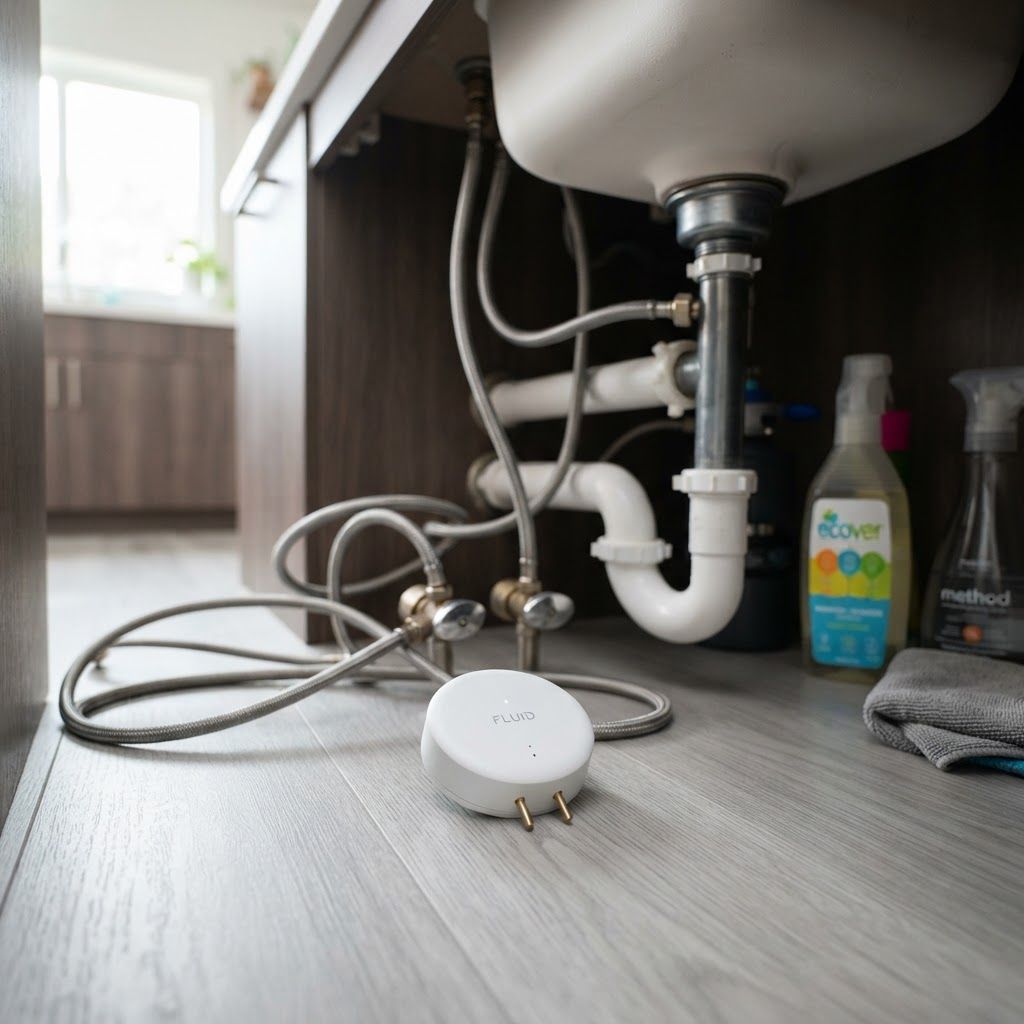
A $13 Device That Can Stop a $12,000 Disaster
Water damage and freezing accounted for roughly 23.5% of all U.S. homeowners insurance losses in recent industry data, and the average claim runs north of $12,000. A burst washing machine hose, a slow drip behind a dishwasher, or a failing water heater can wreck flooring, drywall, and belongings while you sleep or while you’re at work. That’s exactly the gap a smart water leak detector for home protection fills: it catches water where it shouldn’t be and pings your phone in seconds, whether you’re in the bedroom or on vacation three time zones away.
I’ve spent the last few weeks digging through plumber reviews, insurance industry guides, and independent testing from outlets like Wirecutter to figure out which detectors are actually worth buying in 2026. The short version: you can spend as little as $13 or as much as $5,000 (installed), and the right choice depends on whether you rent or own, and whether you want alerts only or a system that shuts your water off by itself.
What a Smart Water Leak Detector for Home Actually Does
At its simplest, a smart leak detector is a small sensor that sits on the floor near a risk point, like under the kitchen sink or behind the toilet. Two metal contacts on the bottom sense when water touches them. The device then does two things: it sounds a built-in siren (usually 85-100 dB, loud enough to hear through a floor) and sends a push notification to your phone over Wi-Fi.
That’s the basic contract. From there, products climb a ladder of sophistication:
- Point-of-leak sensors ($13-$50): battery-powered pucks that alert only. You place several around the house.
- Flow monitors (around $200): strap onto your water meter and track usage patterns, catching invisible leaks like a running toilet.
- Active shutoff systems ($580 device, $3,000-$5,000 installed): a smart valve on your main water line that closes itself when it detects a leak, stopping the water whether you saw the alert or not.
My honest take after reading hundreds of owner reviews: most people underestimate the “silent leak” problem. The catastrophic burst is rare. The toilet flapper that quietly wastes 200 gallons a day and the fridge ice line that seeps behind a wall for three weeks? Those are the ones that quietly cost people thousands. A smart water leak detector for home use catches both.
Passive Sensors vs. Active Shutoff Systems
Before looking at specific products, understand this one distinction, because it drives 90% of the price difference.
Passive detectors are the battery pucks. They tell you water is present. They cannot stop it. If you’re home, that’s usually fine, you hear the siren and turn off the valve. If you travel a lot or own a rental property, an alert you can’t act on from 2,000 miles away is only half a solution.
Active systems install a motorized valve on your main water line. When sensors or the valve’s own flow analysis detect a problem, the valve closes automatically, typically within seconds. Some insurers explicitly list these devices for premium discounts of 5-15%, and a few carriers in high-risk states like California offer 8-12% off for qualifying shutoff devices.
Practical takeaway: renters and condo dwellers should buy passive multi-packs. Homeowners, especially of older houses with galvanized or polybutylene pipes, should seriously consider an active system.
The 5 Best Smart Water Leak Detectors for 2026 at a Glance
| Product | Key Feature | Price | Best For | Rating |
|---|---|---|---|---|
| Phyn Plus 2nd Gen | Ultrasonic flow sensing + auto shutoff | $579.99 + install | Homeowners wanting whole-home protection | 4.6/5 |
| Moen Flo Smart Water Monitor | Flow turbine + nightly microleak tests + auto shutoff | ~$600 + install | First-time active system buyers | 4.4/5 |
| GoveeLife Smart Leak Detector | Wi-Fi, no hub needed, loud siren | ~$15-$50 per pack | Budget buyers and renters | 4.2/5 |
| Shelly Flood Gen4 | Multi-protocol smart home integration | ~$40 | Smart home tinkerers | 4.0/5 |
| IKEA KLIPPBOK | Matter over Thread, cheapest entry | ~$13 | Apple Home / SmartThings users | 3.9/5 |
Now let’s break down each pick, who it’s for, and where it falls short. I’m ranking these from most to least comprehensive, not best to worst in the abstract, because “best” depends entirely on your plumbing situation and budget.
1. Phyn Plus 2nd Gen — Best Smart Water Leak Detector for Home (Overall)
The Phyn Plus 2nd Gen is the closest thing to a gold standard in whole-home water protection in 2026. It installs on your main water line and uses ultrasonic sensors, the same class of technology hospitals use for flow measurement, to analyze pressure waves 240 times per second. No moving parts touch your water, which matters a lot if you live in a hard-water region where turbines eventually crust over with mineral scale.
Here’s what impressed me most: during its roughly 1,000-hour machine-learning phase, Phyn builds a model of your household’s water habits. It learns that a 90-second draw at 7 a.m. is your shower, not a leak. After that, it can distinguish a dripping faucet from a running toilet from a burst pipe, and it shuts the main valve automatically when it’s confident something is wrong. Independent reviews consistently rate it the most accurate detection available, and it’s recognized by 15 major insurance carriers for premium discounts or installation rebates.
The catch is the total cost. The device lists at $579.99, but it requires professional plumbing installation on your main line, and real-world project totals run $3,000 to $5,000 depending on pipe configuration. It also needs a nearby power outlet.
- Pros: ultrasonic sensing with no moving parts to jam, automatic shutoff, fixture-level water usage tracking, insurer-recognized for discounts, catches pinhole leaks other systems miss.
- Cons: $3,000-$5,000 installed is a serious investment, requires pro installation, needs AC power at the main line.
Pro tip: Before buying, call your home insurer and ask which shutoff devices qualify for a discount. Some carriers cut premiums 5-15% for recognized systems, and a few partner with manufacturers for rebates that meaningfully offset the install cost. Every dollar of discount compounds over the years you own the house.
2. Moen Flo — Best Active System for First-Time Buyers
The Moen Flo Smart Water Monitor and Shutoff is Phyn’s closest rival, and for many households it’s the smarter buy. It uses a flow-based turbine to measure every drop moving through your main line, and every night it runs a “microleak test”: it briefly closes the valve and watches whether pressure drops. If it does, water is going somewhere it shouldn’t, and you get an alert with a severity score.
The app experience is where Flo wins points with first-timers. Setup, daily health checks, and consumption trends are presented more simply than Phyn’s data-dense dashboard, which veteran reviewers repeatedly note. Device cost is around $600 with professional installation on top, so the all-in number lands in similar territory to Phyn.
One trade-off worth knowing: the turbine has physical moving parts in the water stream. In hard-water areas, plumbers report more scale-related maintenance concerns over years of service compared with ultrasonic designs. If your area has notoriously mineral-heavy water, that’s a real consideration, not a dealbreaker.
Verdict: pick Flo if you want an active system with the friendliest learning curve; pick Phyn if you want maximum detection precision and no moving parts.
3. GoveeLife Smart Leak Detector — Best Budget Pick
If the Phyn is a home security system, the GoveeLife is a smoke detector, and I mean that as a compliment. It’s the detector Wirecutter recommends in its smart leak detector guide (around $28 for the recommended configuration on Amazon), with multipacks often dropping the per-sensor cost to $15-$20.
Each sensor connects directly to your 2.4 GHz Wi-Fi, no hub required, pairs in about two minutes, and fires both a loud local siren and a push notification when its contacts get wet. Battery life is solid, and replacement batteries are cheap and standard.
- Pros: dirt-cheap per sensor, no hub, genuinely loud alarm, easy app, works for renters (no plumbing modifications).
- Cons: alert-only, can’t stop water; Wi-Fi dependency means notifications won’t arrive during an internet outage (though the local siren still sounds); 2.4 GHz only.
My take: every home, rented or owned, should have a few of these regardless of what else you buy. They’re the cheapest insurance-adjacent gadget on the market. Pair them with a smart plug setup so a detected leak can at least cut power to the washing machine, and you’ve covered the most common failure point for under $60 total.
4. Shelly Flood Gen4 — Best for Smart Home Builders
The Shelly Flood Gen4 (about $40) is the choice for people who already run a serious smart home and want a leak sensor that integrates with everything. Shelly devices are beloved in the home automation community because they support multiple protocols and local control, so alerts and automations keep working even when the cloud doesn’t.
The killer feature here is automation chaining. When the Shelly detects water, it can trigger any connected routine: shut off a smart valve (Shelly makes one), kill power to appliances, blink every light in the house red, and ping you through your preferred platform. That flexibility is why tinkerers rate it above glossier mainstream brands.
The downside: configuration takes real patience. This is not a two-minute app pairing like Govee; it rewards people who enjoy fiddling. If the phrase “local MQTT broker” means nothing to you, buy the Govee instead.
5. IKEA KLIPPBOK — Best Matter Pick Under $15
At roughly $13, IKEA’s KLIPPBOK is the cheapest credible way into leak detection in 2026, and it’s future-proofed by supporting Matter over Thread. That means it works simultaneously with Apple Home, Amazon Alexa, Google Home, and SmartThings, something very few sub-$15 devices can claim.
Two honest caveats. First, it needs IKEA’s DIRIGERA hub to bridge Thread devices to your network, so the real entry cost is sensor plus hub unless you already own one. Second, Thread’s ultra-low power design gives it excellent battery life, but the siren is noticeably quieter than Govee’s, so it’s a weaker choice if you rely on the local alarm to wake you at night.
Best use: apartments and smaller homes where you’re already in the Apple or SmartThings ecosystem and want “good enough” coverage for the price of two coffees.
Where to Place a Smart Water Leak Detector in Your Home (Room by Room)
Placement matters more than brand. A $50 sensor in the wrong spot loses to a $13 sensor in the right one. Work through this checklist:
- Kitchen: under the sink (supply line failures) and behind the refrigerator if it has an ice maker or water dispenser.
- Laundry room: behind the washing machine, where burst hoses are the single most common catastrophic leak source. Wall-mounted brackets beat floor placement here since water pools a few feet away.
- Water heater closet: on the floor of the drip pan. Water heaters fail from the bottom up, and a 40-gallon tank emptying through a ceiling is a five-figure event.
- Bathrooms: behind toilets, especially older ones with original supply lines and rusted shutoff valves that won’t actually close.
- Basement or crawlspace: near the main line, sump pump, and any visible pipe joints, the lowest points where water collects first.
- HVAC condensate: beside the drain pan if your furnace or air handler has one; clogged condensate lines cause slow ceiling damage above finished spaces.
Pro tip: sensors die when batteries die. Set a calendar reminder to test each sensor every six months (most apps have a “test” button), and don’t stack sensors behind appliances where you’ll never notice a dead unit.
Can a Smart Water Leak Detector for Home Lower Your Insurance?
Often, yes, and this is the most overlooked money angle in the whole category. Insurers including USAA, Amica, and several others offer premium discounts for leak detection and mitigation devices, typically 5-15%, with some carriers in water-loss-heavy states like California offering 8-12% specifically for smart shutoff systems. USAA even sells subsidized leak detection kits starting around $112 through its Perks program.
The math gets interesting fast. A homeowner paying $2,000 a year in premiums who gets a 10% connected-home discount saves $200 annually, forever. That pays back a $60 Govee multi-pack in four months, and it meaningfully softens the financing case for a Phyn or Flo install over a five-to-ten-year horizon.
Two rules, though: discounts for alert-only sensors are rarer and smaller than for systems with automatic shutoff, and your specific carrier’s list of qualifying devices governs. Call before you buy, not after. If you rent, the calculus differs: check our guide to the cheapest renters insurance for apartments, where water damage liability for a leak you caused is the real exposure.
How Much Can You Actually Save? Running the Numbers
Let’s make this concrete with a typical scenario. Average water damage claim: about $12,000. Out-of-pocket even with good insurance: deductible (say $1,000) plus premium increases for years after a claim, often 20-30% at renewal. Realistic total cost of one mid-size incident: $2,500-$4,000 out of pocket over three years.
Prevention stack: three Govee sensors ($45) plus, for owners, a $200 flow monitor or a financed active system. Even the passive stack alone turns most catastrophic two-hour disasters into 20-minute mop-ups, because you know within minutes, not days.
Compare that with the other money-saving smart home gear we’ve covered: a smart home energy monitor typically pays back through 5-10% bill reductions, and smart plugs killing standby power save a few dollars a month. A leak detector’s value is lumpy: $0 most years, potentially $10,000+ the year it fires. That’s the same risk logic as insurance itself, except the device costs less than most deductibles.
Our Pick for 2026
For most people, the answer is stacked, not either/or. Start with a GoveeLife multipack today (under $50, ten-minute setup, protects the laundry and water heater immediately). If you own your home, add a phone call to your insurer about shutoff-system discounts, and budget toward a Phyn Plus 2nd Gen if you want the best detection accuracy on the market or a Moen Flo if you prefer the friendlier app. If you’re deep into Apple Home or SmartThings and want to spend as little as possible, the IKEA KLIPPBOK is a remarkably capable $13 starting point.
The worst decision is the one too many homeowners make: nothing, until the ceiling comes down. One burst hose on a Saturday grocery run can cost more than every smart device in this article combined, installed, and insured for a decade. Pick your budget tier and put something under that sink this week.
Frequently Asked Questions
Where should I place a smart water leak detector in my home?
Focus on the highest-risk spots: under the kitchen sink, behind the washing machine, in the water heater’s drip pan, behind toilets, next to any fridge ice line, and near the main water line or sump pump in the basement. Start with the laundry machine and water heater, the two most common catastrophic leak sources.
Do smart water leak detectors work without Wi-Fi?
Partially. The built-in siren is local and always works. But push notifications to your phone need the internet. Devices using Thread or Zigbee with a hub keep reporting locally on your network even if the wider internet drops. Active shutoff systems like Phyn and Moen Flo can still close the valve during connectivity loss for major leak events.
Can a smart water leak detector shut off my water automatically?
Point-of-leak sensors can’t, they only alert. Active systems like the Phyn Plus 2nd Gen and Moen Flo install a motorized valve on your main line and shut off the whole house automatically when a leak is detected, even if you’re away from your phone.
How much does a smart water leak detector cost?
Passive sensors run from about $13 (IKEA KLIPPBOK) to $50 (Shelly, Govee multipacks). Flow monitors cost around $200. Whole-home shutoff systems like Phyn Plus 2nd Gen list at $579.99 for the device, with professional installation bringing totals to $3,000-$5,000.
Does a water leak detector lower home insurance?
Frequently. Many U.S. insurers offer 5-15% premium discounts for leak detection devices, with the largest discounts reserved for automatic shutoff systems. USAA, Amica, and several others run dedicated connected-home programs. Always call your carrier before buying to confirm which devices qualify.