

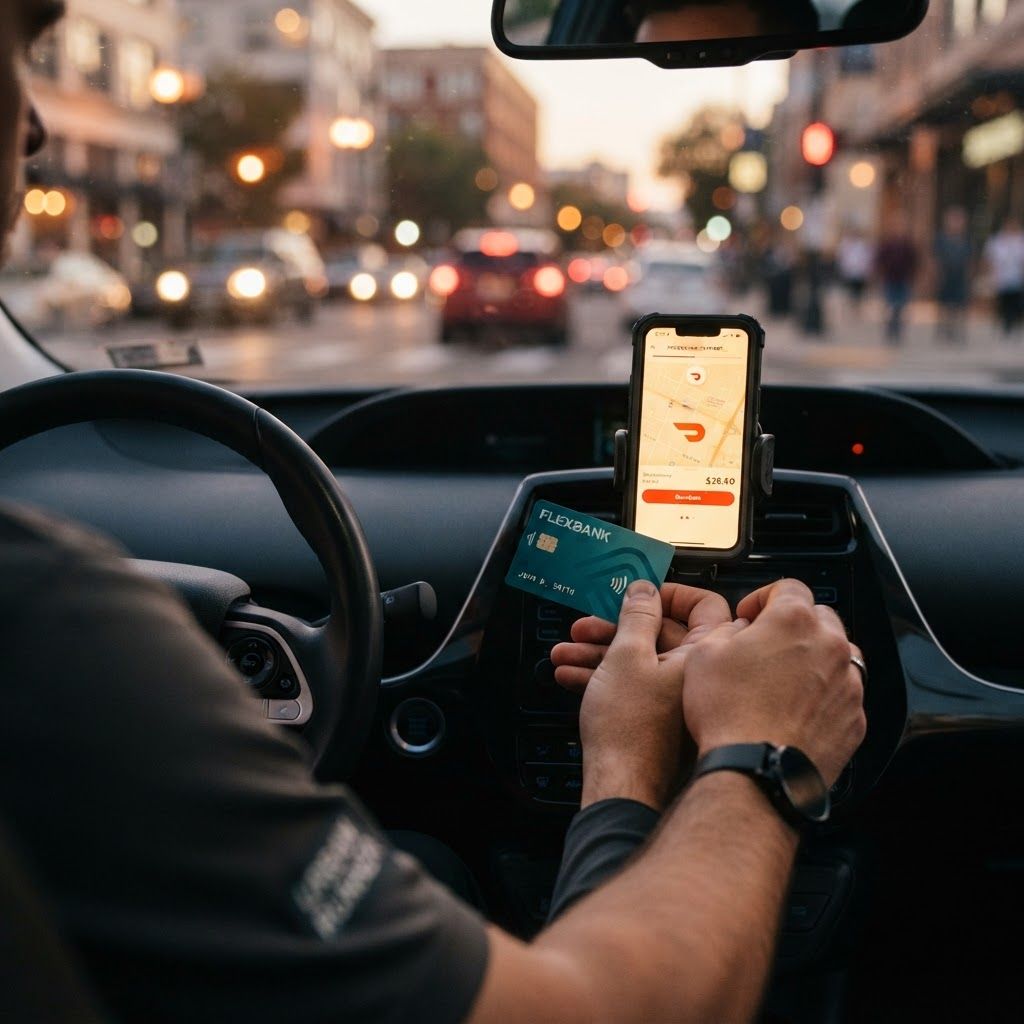
The Best Credit Card for Gig Workers in 2026: Stop Paying Your Own Expenses for Free
Every time a DoorDash driver fills the tank with a debit card, an Instacart shopper pays her phone bill on a 1% cash back card, or an Uber driver buys windshield wipers on whatever plastic is closest, free money stays on the table. The best credit card for gig workers exists for exactly these purchases, and in 2026 there are a handful of cards that pay 3% to 5% in the categories where gig workers already spend the most: gas, cell phone service, internet, and supplies.
Here is the problem. Gig income is messy. You are not an employee, you probably do not have an LLC, and your expenses swing wildly from week to week. Most “best credit card” roundups are written for office-based freelancers or small business owners with predictable spending. That advice misses the mark for people whose workplace is the driver’s seat of a 2014 Corolla.
The good news is that card issuers count you as a business anyway. If DoorDash, Uber, Lyft, Instacart, or Amazon Flex pays you as an independent contractor and sends you a 1099, you can qualify for business credit cards as a sole proprietor, no LLC required. That unlocks a tier of cards with bigger rewards on exactly the spending you already do. Below, I compare the five that make the most sense for gig workers this year, with real rewards rates, fees, and welcome bonuses, and I tell you exactly which card fits which type of driver.
Why You Should Keep Gig Spending on Its Own Card
Before we get to the cards, a quick word on why it matters. If your DoorDash gas receipts live on the same card as your Netflix subscription and your Friday night pizza, tax season becomes an archaeology project. A dedicated card gives you a clean paper trail for the IRS, protects your personal credit utilization, and lets you actually see whether the gig is profitable.
- Clean tax records. Every dollar on the card is a candidate business expense: gas, oil changes, wipers, phone mounts, dash cams, data plans, and even interior cleaning supplies. One monthly statement replaces that shoebox of crumpled receipts.
- Higher rewards ceilings. Business cards compete aggressively on gas, phone, and utility categories. Personal cards mostly compete on dining, groceries, and streaming. Guess which list matches gig work.
- Your personal credit stays clean. Most business card spending is not reported to the personal credit bureaus, so putting $800 of gas on the card does not spike your utilization before a mortgage or car loan application.
- You finally see real profit numbers. When all gig spending sits in one place, you can divide rewards-eligible expenses by earnings and know whether you made $14 an hour or $6. Many part-time drivers discover they were closer to the second number until they got organized.
One important note: most drivers still take the standard mileage deduction at tax time rather than itemizing actual expenses, since it is simpler and often worth more. A dedicated card does not replace that choice, but it gives you the documentation to compare both methods. And since rewards on business purchases can interact with deductions, mention your cash back to your tax preparer.
How We Chose the Best Credit Card for Gig Workers
I scored each card against how gig workers actually spend, using typical driver cost breakdowns from driver communities and the published 2026 terms for each card. Five criteria decided the ranking:
- Gas and EV charging rewards, since fuel is the number one recurring expense for delivery and rideshare drivers
- Cell phone and internet rewards, the unavoidable second expense for anyone who works through an app
- A $0 annual fee. Paying a fee to earn cash back on a side hustle is a bad trade unless you drive full-time hours, and even then the math rarely works
- Cash back over points or miles, because most gig workers want money that offsets this month’s gas, not aspirational first-class redemptions
- A reachable welcome bonus, judged against realistic gig-related spending of $600 to $1,500 per month, not inflated “business” spending figures
I also confirmed every card below accepts sole proprietors. You can apply with your Social Security number, your own legal name as the business name, and your 1099 income as business revenue. Just know that an application still triggers a personal credit inquiry with most issuers, and you personally guarantee the debt. That is standard, but it belongs in the fine print of your decision.
The 5 Best Credit Cards for Gig Workers at a Glance
Here is the short version. Rates below reflect published 2026 terms and issuers change offers periodically, so double-check the issuer’s page before applying.
| Card | Best For | Top Rewards | Annual Fee | Our Rating |
|---|---|---|---|---|
| U.S. Bank Triple Cash Rewards Visa Business | Gas-heavy delivery and rideshare drivers | 3% at gas stations and EV charging, 3% phone plans, 3% office supplies | $0 | 4.8/5 |
| Chase Ink Business Cash | Phone, internet, and supply spend; deal hunters | 5% on phone, internet, cable, office supplies (first $25K/yr); 2% gas and restaurants | $0 | 4.6/5 |
| Amex Blue Business Cash | Multi-app workers with mixed spending | Flat 2% on everything (first $50K/yr), then 1% | $0 | 4.5/5 |
| Citi Double Cash | Gig workers who want to avoid business cards | 2% total: 1% when you buy, 1% when you pay | $0 | 4.3/5 |
| Chase Ink Business Unlimited | Big welcome bonus, zero effort | Flat 1.5% on everything plus a $750 bonus potential | $0 | 4.2/5 |
1. U.S. Bank Triple Cash Rewards Visa Business Card: Best for Drivers Who Live at the Pump
Gas is the biggest recurring cost for delivery and rideshare drivers, so a card that pays 3% at gas stations and EV charging stations is the closest thing to a raise you will ever get from a piece of plastic. The U.S. Bank Triple Cash Rewards Visa Business Card also pays 3% at office supply stores and on eligible cell phone service provider purchases, with 1% on everything else and a $0 annual fee.
The math compounds quickly. A driver spending $500 a month on gas earns about $180 a year back on fuel alone. Add 3% on a $90 phone plan and you pass $210 before counting office supply runs for hot/cold bags and delivery gear. Recent welcome offers on this card have ranged from roughly $300 to $500 in value after about $3,000 of spending in the first few months: a moderately active driver clears that by routing gas, phone, and car expenses through the card for a season.
Two honest caveats. First, if you drive an EV and charge at home, your charging may post as a utility instead of an EV charging station, which would miss the 3%. Public charging networks generally post correctly. Second, U.S. Bank’s approval tends to be a bit stricter than Chase or Amex on thin credit files, so this is the card for drivers whose personal credit is already in decent shape.
2. Chase Ink Business Cash: Best If Your Phone Bill Is Your Second Biggest Expense
Most gig workers never realize their phone and internet bills are their biggest deductible overhead after fuel. The Chase Ink Business Cash card pays 5% cash back on the first $25,000 per year at office supply stores and on phone, internet, and cable services, plus 2% on the first $25,000 combined per year at gas stations and restaurants, then 1%. No annual fee.
That 5% on phone and internet is already strong for a driver with a $90 unlimited plan plus a $60 home internet line: about $90 a year back on bills you were going to pay anyway. Now here is the enthusiast trick that makes this card a legend in the side hustle community: office supply stores sell gift cards for gas stations, restaurants, and major retailers. Buying those gift cards at an office supply store with this card can earn the full 5% on spending the card would otherwise pay 1% on. It is legal, it is within the terms, and it is the reason the Ink Cash keeps winning best-business-card awards year after year in 2026 roundups.
Chase business cards in this family also regularly carry a $750 welcome bonus after $6,000 spent in the first 3 months. A full-time driver hits that with gas alone in about four months, so pair it with a driver who batches phone, internet, insurance, and supply purchases onto the card. And because Ink Cash rewards are Ultimate Rewards points, they can transfer to airline and hotel partners later if you ever add a premium Chase card and catch the travel bug.
3. American Express Blue Business Cash: Best Flat-Rate Card for Multi-App Chaos
If you dash on Tuesdays, run Instacart on weekends, and flip furniture on Facebook Marketplace the rest of the week, your spending refuses to fit into tidy categories. The Amex Blue Business Cash pays a flat 2% cash back on every purchase up to $50,000 per year, then 1%, with a $0 annual fee and zero category management.
Flat 2% is deceptively strong. A worker running $1,200 a month through a chaotic mix of gas, packaging, cleaning supplies, parking, and coffee for waiting-in-the-parking-lot marathons earns just under $290 a year without tracking anything. Amex welcome offers on this card appear and disappear throughout the year, often a few hundred dollars after a few thousand in spending, so if a fat offer is live when you apply, take it, and if not, the card still earns its place on flat rate alone.
Amex is also friendlier than most issuers to side hustles counting themselves as businesses, and the Blue Business Cash sits on their no-annual-fee roster, meaning you are never re-deciding whether it deserves its wallet slot. For a gig worker who wants one card, one rate, and no weekend research sessions, this is that card.
4. Citi Double Cash: Best If You Do Not Want a Business Card at All
Some readers have no interest in business card applications, and that is a completely valid way to live. The Citi Double Cash Card pays a total of 2% back on everything: 1% when the purchase posts, and another 1% when you actually pay it off. There is no annual fee and no categories to remember.
That pay-to-earn structure doubles as a discipline feature: you only collect the full 2% if you pay the bill, a nudge that protects you from floating balances. The tradeoffs are real, though. You lose the business card perks: the cleaner bookkeeping separation at tax time and the fatter category rates on gas and phone bills. Pairing Double Cash with a solid bill and expense tracker app recovers most of the organizational benefit if you go this route.
5. Chase Ink Business Unlimited: The Flat 1.5% With the Big Bonus
The Ink Business Unlimited is the simpler sibling of the Ink Cash. It skips categories entirely and pays a flat 1.5% cash back on all purchases, and it regularly carries the same $750 welcome bonus after $6,000 in the first 3 months as its category-focused twin. It is a legitimate pick if you want one business card, a headline bonus, and no interest in optimization.
In a pure long-run comparison, 1.5% flat loses to 3% on gas or 5% on phone bills for typical gig spending. My honest take: pick the Unlimited only when the welcome bonus is running and a category card like the Triple Cash is out of reach, then collect the bonus and enjoy the simplicity.
Pros and Cons of Business Credit Cards for Gig Work
Before you apply for anything, weigh the tradeoffs that are specific to earning 1099 income rather than a salary:
Pros
- Higher rewards in gas, phone, and supply categories than comparable personal cards
- Clean expense trail that makes Schedule C deductions nearly automatic
- Welcome bonuses from roughly $300 to $750 that realistic gig spending can reach in months, not years
- Applications accept sole proprietors with 1099 income: no LLC, no EIN, no business plan
- Most business card spending is not reported to personal credit bureaus, keeping utilization low when you spend heavily
Cons
- Business cards have weaker legal protections than consumer cards, with fewer restrictions on fees and rate changes
- Your personal credit is still checked when you apply, and you personally guarantee the balance
- Category caps at $25,000 or $50,000 per year mean heavy spenders eventually drop to 1%
- Issuers sell multiple versions of similar-sounding cards: always confirm you are applying for the $0 annual fee version
- Carrying a balance at 20%+ APR erases cash back ten times faster than you earn it: these cards are tools, not loans
Which Card Fits Your App?
Your spending pattern, not the marketing, should pick the card. Match your primary app to your plastic:
- DoorDash, Uber Eats, Grubhub drivers: U.S. Bank Triple Cash Rewards. Gas is your fuel bill and nothing else pays 3% on it with no annual fee.
- Uber and Lyft rideshare drivers: Triple Cash for gas-heavy schedules, or Amex Blue Business Cash if you moonlight across apps and buy cleaning supplies constantly.
- Instacart and Shipt shoppers: Amex Blue Business Cash flat 2%, because your card spend is small purchases everywhere rather than a weekly $60 fill-up.
- TaskRabbit, Handy, thumbtack pros, furniture flippers: Chase Ink Business Cash, then buy gas and store gift cards at office supply stores for the 5% trick.
- Multi-app maximizers: pair a category card for fuel with a flat-rate card for everything else, and keep genuinely personal spending on your everyday rewards card so deductions stay clean.
How to Apply as a Gig Worker (It Is Easier Than You Think)
The application takes about ten minutes once you know what each field expects. Here is the cheat sheet:
- Business name: your legal name. Sole proprietors do not need a DBA or registered business name.
- Legal structure: sole proprietorship.
- Business category or industry: “Other” if the list lacks rideshare or delivery; some applications offer a transportation option.
- Annual business revenue: your realistic 1099 gig earnings. Round honestly. Outrageous numbers invite verification, honest numbers rarely get challenged.
- Monthly spend estimate: only the expenses you will actually route through the card, typically fuel, phone, internet, and supplies.
- Tax ID: your Social Security number if you have not applied for an EIN (you do not need one).
Approval odds depend mostly on your personal credit score: 680 or above gives you a realistic shot at every card on this list, and you may generally include household income alongside business income on the application. If your credit history is thin, start with a starter card instead, the way we explain in our guide to first credit cards for students and beginners, then graduate to a business card after a year of on-time payments.
Whoever issues your card, use it like a debit card with a delay: pay the balance weekly if your discipline wobbles. One month of carried interest on these cards costs more than a full year of 3% gas rewards.
Stack Your Card With Organizational Habits, Not More Cards
The card is only half the system. The other half is the boring plumbing that makes gig work survivable: separate the money, track the bills, and invoice like a business instead of a person hoping the app pays out. Pair your new card with a simple budgeting app for the personal side, and if your side hustle involves clients rather than apps, our free invoicing tools comparison covers the paperwork side. One card, one tracker, one invoice tool: that is the entire back office of a professional gig operation.
Our Verdict
For most full- and part-time drivers, the U.S. Bank Triple Cash Rewards Visa Business Card is the best credit card for gig workers in 2026: it pays 3% on the gas and EV charging that dominate your expenses, 3% on your phone bill, charges no annual fee, and carries a welcome bonus sized for real side-hustle spending rather than corporate budgets. If your work looks less like driving and more like shopping, flipping, or task-running, take the flat 2% simplicity of the Amex Blue Business Cash. And if you enjoy squeezing every dollar, the Chase Ink Business Cash and its gift card strategy is the enthusiast play that pays 5% on bills you cannot avoid.
Whichever card you pick, the real win is behavioral. All gig spending on one card, paid in full every week, categorized by tax time without a single receipt hunt. The cash back is the bonus. The clean books and the honest look at your real hourly earnings are the actual paycheck.
Frequently Asked Questions About Credit Cards for Gig Workers
1. Can a gig worker really get a business credit card?
Yes. Card issuers accept sole proprietors, which includes anyone earning 1099 income from apps like DoorDash, Uber, Lyft, Instacart, or TaskRabbit. You apply with your Social Security number, your own legal name as the business name, and your gig earnings reported as business revenue. No LLC, EIN, registered business, or separate bank account is required for the cards in this article.
2. Do business credit cards check my personal credit score?
Almost always, yes. Most issuers run a hard personal credit inquiry when you apply, and you personally guarantee the debt. The upside is that most business card spending is not reported to the personal credit bureaus afterward, so heavy fuel purchases will not inflate your personal credit utilization ratio.
3. Which credit card is best for DoorDash and Uber Eats drivers?
The U.S. Bank Triple Cash Rewards Visa Business Card, because its 3% back at gas stations matches the driver’s biggest expense. If your gas spend is mild or you rely mostly on public charging, a flat 2% card like the Amex Blue Business Cash or Citi Double Cash can come out ahead by paying more on everything else.
4. Is 3% back on gas actually meaningful for a gig worker?
At $400 to $600 of fuel per month, 3% returns roughly $145 to $215 per year. Cash back does not reduce your standard mileage deduction, though rewards tied to business purchases may be taxable income or reduce deductible expenses in some situations, so keep your tax preparer in the loop.
5. Should I pay off my gig card weekly or monthly?
Weekly, if discipline is a struggle. These cards can charge APRs above 20%, and one month of carried interest erases a year of rewards. Weekly payments also keep your available credit high during heavy delivery weeks, and they force you to look at your actual spending every seven days, which is where the real profit insights come from.
Related Articles
- Best Budget App for Beginners in 2026: 5 Options Compared
- Best Rewards Card for Everyday Purchases in 2026: 4 Options Compared
- Free Invoicing App for Freelancers in 2026: 7 Tools Compared
- Best Side Hustles for College Students in 2026: 9 Flexible Ways to Earn
- High Yield Savings Account for Beginners in 2026: How It Works and 5 Top Picks