

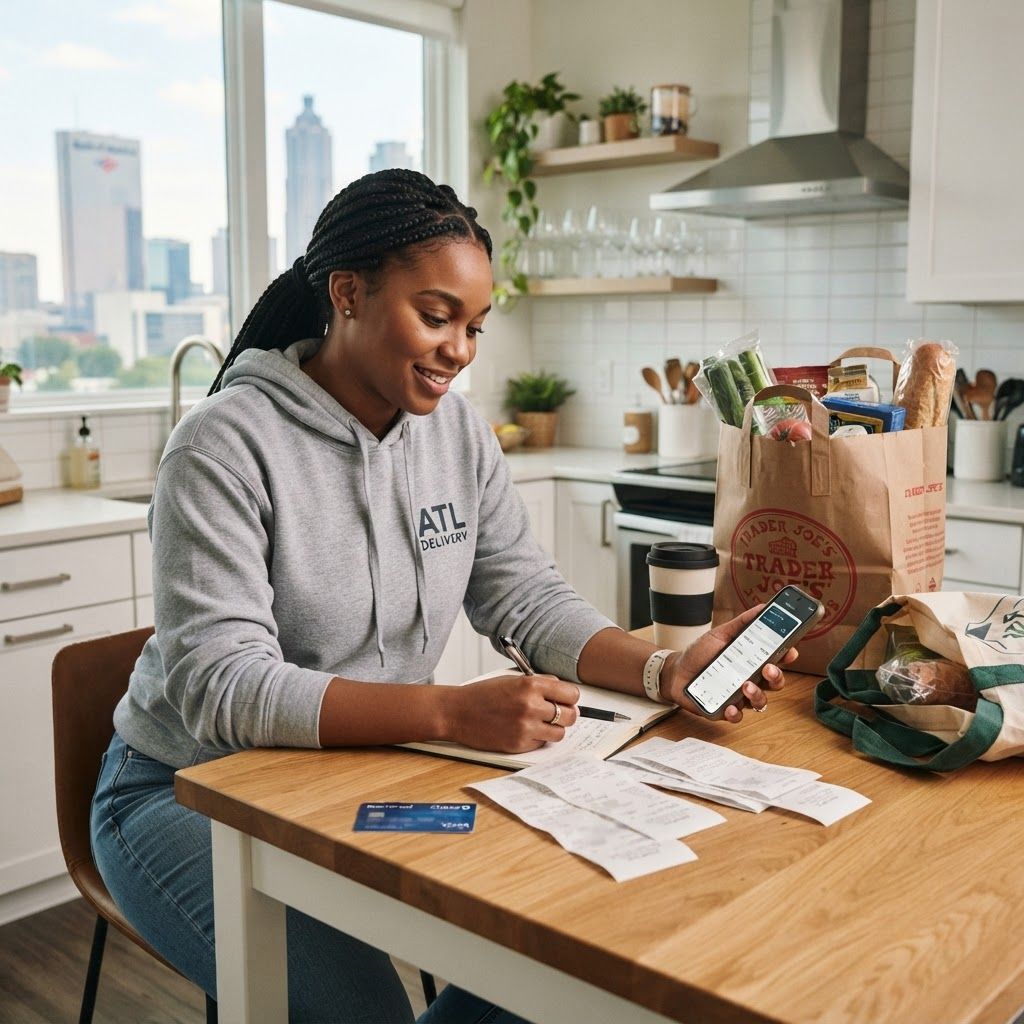
The best cashback credit cards for Atlanta food delivery drivers buying gas and groceries in 2026
If you deliver for DoorDash, Uber Eats, Instacart, Grubhub, or local Atlanta restaurants, two expenses usually arrive every week: fuel and food. The best cashback credit cards for Atlanta food delivery drivers buying gas and groceries in 2026 can turn those predictable purchases into statement credits or cash rewards, but only when the rewards match your routes, credit profile, and tax habits.
Atlanta drivers face a different pattern from a typical commuter. A shift may run from Midtown to Buckhead, Decatur, Sandy Springs, and the airport, with several small gas purchases and grocery pickups. The right setup should be simple enough to use between orders and valuable enough to offset annual fees. This guide compares practical options without assuming that every driver has perfect credit or a large monthly budget.
1. Start with your Atlanta delivery spending pattern
Before applying, total the last three months of gas, groceries, restaurant supplies, tolls, and phone expenses. A driver who spends $450 a month on fuel needs a different card from a driver who spends $180 but buys $700 of groceries for Instacart clients. Use bank statements and receipts rather than guesses.
Atlanta traffic can make route length unpredictable, so look at purchases by category, not just miles. Gas stations near I-285, I-75, I-85, and the downtown connector may code differently from warehouse clubs or superstores.
Pro tip: Make a small spreadsheet with columns for date, merchant, category, and business purpose. That record helps you choose a card and makes tax preparation less stressful.
- Separate personal groceries from customer orders.
- Track whether a purchase was made at a supermarket, warehouse club, or superstore.
- Review annual fees against realistic annual rewards.
2. The best all-around option for grocery-heavy routes
For drivers who shop frequently at qualifying U.S. supermarkets, a grocery-focused cashback card can be powerful. The Blue Cash Preferred from American Express is commonly known for a high supermarket earning rate up to its annual cap, followed by a lower rate. Its annual fee means it only makes sense when your qualifying grocery spend is high enough to overcome that cost.
This can fit an Instacart driver who also buys household groceries personally, but read the merchant exclusions. Walmart, Target, warehouse clubs, and some delivery services may not earn the supermarket rate. Never buy extra items merely to reach a reward threshold.
Pro tip: Check the current offer and annual cap directly with the issuer before applying. A high advertised percentage is useful only on purchases that actually qualify.
- Best fit: consistent supermarket spending.
- Watch: annual fee and category cap.
- Confirm: whether Atlanta-area merchants code as supermarkets.
3. A no-annual-fee choice for fuel and flexible spending
A no-annual-fee card such as the Blue Cash Everyday from American Express may be easier for a newer driver or someone with uneven seasonal income. It can earn rewards on eligible U.S. supermarket and U.S. online retail purchases, with a lower rate than premium grocery cards. The absence of an annual fee reduces the risk during slow months.
For fuel, compare cards that offer a flat rate everywhere with cards that use rotating or limited categories. A simple 2% card may beat a complicated bonus card if you forget to activate quarterly categories or if fuel stations do not qualify as expected.
Pro tip: Put the card in your delivery wallet and use it only for budgeted operating costs. Rewards disappear quickly when interest charges exceed the cashback.
- Best fit: variable income and modest spending.
- Watch: online retail and supermarket definitions.
- Use autopay for at least the statement balance.
4. When a flat-rate card beats category chasing
Flat-rate cashback cards are often the cleanest choice for Atlanta drivers who buy fuel at many different stations, pay for parking, or split expenses across gas, maintenance, and supplies. A 2% card may produce less headline cashback than a specialized card, but it works without tracking rotating calendars.
This approach is especially helpful for drivers who move between neighborhoods and cannot choose the same station every time. It also avoids the category confusion that can happen with warehouse clubs, convenience stores, and mobile wallet purchases.
Pro tip: Estimate rewards using your real monthly spend. Reliability is a feature when you are driving during a busy dinner rush.
- Best fit: mixed business purchases.
- Watch: foreign transaction fees if you travel.
- Compare redemption minimums and statement-credit rules.
5. How to maximize gas rewards without changing routes
Do not drive across Atlanta to earn an extra fraction of a percent. Compare the reward with the extra fuel, time, and missed delivery opportunity. A nearby station with a fair price and a dependable bonus is usually better than a distant station with a slightly higher rate.
Check whether a card rewards gas purchases directly or only certain merchants. Some fuel rewards programs require enrollment, while others apply automatically. Keep receipts for car washes, oil changes, and maintenance separately because they may not code as gas.
Pro tip: Choose a primary card and one backup, then review gas prices weekly with the same route. The best reward is the one that does not reduce your delivery income.
- Compare station price before cashback.
- Do not carry a balance for rewards.
- Record business mileage separately from card purchases.
6. Credit scores, approvals, and safer applications
Applying for several cards at once can be risky, especially if your income varies. Start with one card that matches your current credit profile. Review the issuer’s stated credit range, annual fee, welcome offer requirements, and reporting policies.
Self-employed delivery income should be reported accurately on an application. Do not inflate revenue, and do not count the same money twice. If you are rebuilding credit, a secured card or a card with a lower limit may be more realistic than a premium rewards product.
Pro tip: Apply only after checking your credit reports for errors. Approval matters more than a theoretical rewards rate.
- Start with one application.
- Keep utilization low before the statement closes.
- Read issuer terms rather than relying on social media claims.
7. Keep rewards and tax records separate
Cashback is generally treated as a purchase rebate rather than ordinary income when it is tied to purchases, but tax treatment can vary by situation. The card statement is not a mileage log and it does not prove that every purchase was business-related. Keep a separate mileage app, receipt folder, and monthly income record.
For a deeper operational system, see our guide to mileage tracker apps for gig drivers. You can also compare bookkeeping apps for freelancers before tax season.
Pro tip: Reconcile your card statement every week, not once a year. Small corrections are easier while the order is still fresh.
- Save digital receipts by month.
- Mark personal reimbursements clearly.
- Ask a tax professional about your specific deductions.
8. A simple Atlanta card setup for 2026
For many drivers, the practical setup is one no-annual-fee flat-rate card for mixed operating costs, plus a grocery-focused card only if supermarket spending is consistently high. Pay in full, review category definitions, and cancel nothing impulsively if it would hurt your credit history.
Use a monthly test: calculate fuel and grocery rewards, subtract annual fees, then compare that total with a simple no-fee alternative. If the premium card does not win by a comfortable margin, simplicity is probably the better choice.
Pro tip: Recalculate after three months of real Atlanta driving. Your actual route data is more useful than a generic rewards ranking.
- Primary card: the category you use most.
- Backup card: dependable flat-rate rewards.
- Monthly check: rewards, fees, interest, and records.
For Atlanta food delivery drivers, the best cashback credit cards are not necessarily the ones with the biggest marketing number. Choose the card that matches your gas and grocery merchants, keeps fees under control, and supports accurate records. Start with your actual spending, pay balances on time, and review the terms before every application.
Frequently Asked Questions
What is the best cashback credit card for Atlanta food delivery drivers?
It depends on whether you spend more at qualifying supermarkets, gas stations, or mixed merchants. Compare a grocery-focused card with a no-fee flat-rate card using your real statements.
Do credit cards give cashback on gas for delivery drivers?
Some cards offer gas bonuses, while others provide a flat rate. Check the issuer’s current category terms and how each station codes the purchase.
Can Instacart drivers use a grocery rewards card?
Yes, but qualifying depends on the merchant category code and the card terms. Warehouse clubs, superstores, and delivery platforms may not qualify as supermarkets.
Should a gig worker choose a card with an annual fee?
Only when expected eligible rewards clearly exceed the fee and you can pay the balance in full. Variable income makes no-fee options safer for many drivers.
Are cashback rewards taxable for delivery drivers?
Cashback tied to purchases is commonly treated as a rebate, but individual tax situations differ. Keep records and consult a qualified tax professional.