
Best smart home devices for night-shift renters in Nashville
If you work nights in Nashville, your bedroom has to do something most rooms do not: create a dependable daytime sleep environment while the city is active outside. The best smart home devices for night-shift renters in Nashville are compact, renter-friendly tools that reduce light, noise, heat, and interruptions without drilling into walls or changing permanent wiring.
That matters in apartments near busy corridors, hospitals, warehouses, and downtown nightlife. A simple setup built around smart plugs, blackout control, climate management, and air quality can cost roughly $100 to $350, depending on how much automation you want.
1. Start with a smart bedside lamp and smart plug
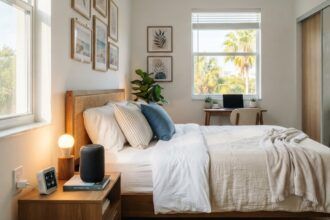
A smart plug is the easiest first upgrade because it lets you automate an existing lamp. Use a warm, dimmable bulb and schedule it to turn on gradually before your alarm. For a rental bedroom, choose a compact plug rated for the lamp’s load and keep the cord visible rather than hiding it under bedding.
Pro tip: Set a “sleep” scene that turns off the lamp, lowers notifications, and starts a fan or white-noise machine at the same time.
Result: fewer decisions after a long shift and a calmer transition into sleep.
- Typical smart plug price: $10–$25.
- Warm smart bulb: about $12–$30.
- Look for Alexa, Google Home, or Apple Home compatibility.
2. Use renter-friendly blackout control
Daylight is usually the biggest problem for night-shift workers. Begin with blackout curtains installed on a tension rod or an existing curtain rod. If you want automation, a retrofit curtain motor can open and close curtains without replacing the whole window treatment. Check your lease before using adhesive mounts, and test that the motor does not pull against the rod.
Nashville summers can be bright early, so combine blackout curtains with a sleep mask and a consistent closing schedule. The goal is not a high-tech bedroom; it is a repeatable darkness routine.
Pro tip: Close the curtains 15 minutes before you leave for work so the bedroom is already dark when you return.
Result: a more consistent daytime sleep window, even on sunny mornings.
- Basic blackout panels often cost $25–$60 per pair.
- Retrofit curtain motors commonly start around $80.
- Avoid drilling unless your landlord explicitly permits it.
3. Add a quiet smart thermostat routine
Temperature changes can wake you after a night shift. A smart thermostat is useful only if your rental already has a compatible thermostat and the landlord approves replacement. Otherwise, use a temperature sensor, a quiet fan, or a portable AC schedule instead of modifying HVAC wiring.
Set the room slightly cooler for the first part of sleep and warmer near your planned wake time. The exact setting depends on your comfort, but small, predictable changes are better than aggressive swings. A sensor placed near the bed can also reveal whether sunlight or a poorly sealed window is creating heat.
Pro tip: Ask property management about HVAC compatibility before buying a thermostat; incompatible wiring can damage equipment.
Result: fewer wake-ups caused by an overheated or chilly bedroom.
- Temperature sensors: approximately $20–$50.
- Portable fans with app controls: often $30–$70.
- Keep the bedroom thermostat schedule separate from the rest of the apartment when possible.
4. Choose a quiet air purifier for sleep
Air quality can be an issue in any apartment, especially if you live near traffic or share a building with pets and cooking odors. A compact purifier with a true HEPA filter can help with particles, while an activated-carbon layer is more useful for odors. For a bedroom, noise level matters as much as coverage area.
Put the unit several inches away from walls, run it on a higher setting before bed, and switch to sleep mode when you lie down. Replacement filters are a recurring cost, so check their price before choosing a brand.
Pro tip: Do not rely on a purifier to solve mold or ventilation problems; report persistent moisture to your landlord.
Result: cleaner-feeling air without adding a loud appliance to your sleep routine.
- Bedroom-size purifiers commonly cost $60–$180.
- Check annual filter costs, not only the purchase price.
- Keep vents clear and avoid placing the unit directly beside curtains.
5. Build a no-drill wake-up and safety setup
Night-shift workers often return home when roommates or neighbors are asleep. A sunrise alarm or gradually brightening bedside light is less disruptive than a loud phone alarm. Add a smart door or window sensor only if it is allowed by your lease and does not record private conversations.
Use a phone shortcut to trigger the lights, fan, and alarm together. Keep the manual controls accessible in case Wi-Fi fails. Smart devices should make the room more predictable, not create a new troubleshooting job at 7 a.m.
Pro tip: Keep one ordinary lamp and one ordinary alarm as backups.
Result: a quieter wake-up and a safer, more resilient routine.
- Sunrise alarms often cost $30–$100.
- Window sensors generally cost $15–$40.
- Use unique passwords and two-factor authentication for smart-home accounts.
6. Keep the setup simple in a Nashville rental
The best smart home devices for night-shift renters in Nashville are the ones you can take with you. Start with a smart plug, blackout solution, and quiet fan. Add a purifier or sensor only after you know what is actually interrupting your sleep. This approach keeps the budget under control and avoids a bedroom full of devices competing for attention.
Before installing anything, read the lease, ask the property manager about HVAC or security devices, and save original hardware. Apartment communities around Nashville can have different rules about adhesive strips, exterior-facing cameras, and thermostat changes.
Pro tip: Buy one device at a time and test it for a full week before expanding the setup.
Result: a portable sleep system that works across apartments and changing shifts.
Conclusion
A reliable daytime bedroom does not require a full smart-home renovation. For most Nashville night-shift renters, the highest-value combination is blackout control, an automated warm lamp, temperature support, and a quiet air purifier. Choose no-drill options, confirm lease rules, and keep manual backups so technology supports your sleep instead of interrupting it.
Frequently Asked Questions
What is the best first smart-home device for a night-shift renter?
A smart plug paired with a warm bulb is usually the cheapest and most portable starting point.
Can renters install a smart thermostat?
Only if the thermostat is compatible and the landlord or property manager permits the replacement.
How can I make a bedroom darker without drilling?
Use blackout curtains on an existing rod or a properly fitted tension rod, plus a sleep mask if needed.
Are air purifiers worth it for apartment bedrooms?
A quiet, correctly sized purifier can help with airborne particles, but it cannot replace proper maintenance for leaks or mold.
How much does a renter-friendly smart sleep setup cost?
A basic setup can start near $100; a more complete setup with curtains, purifier, sensors, and lighting may reach $350.